Organizational Synchronization & Capability Alignment
4C-Foresee supports enterprise structures in identifying, aligning, and amplifying strategic talent. By fostering an intrapreneurial mindset, removing structural execution silos, and establishing lifelong learning hubs, we transform individual capacity into lasting national progress.
Strategic Talent Sourcing
Modern enterprises rely on a highly concentrated, technically advanced labor layer. True competence requires the continuous alignment of specialized skills, values, and organizational aspiration. Our recruitment framework connects high-performing professionals with strategic roles, reducing transition friction and protecting key executive teams from operational attrition.

The Culture of Active Boldness
True progress happens when individuals within an organization take bold, calculated leaps. By encouraging professional experimentation and providing strategic freedom within clear guardrails, corporate intrapreneurship transforms passive employees into active category innovators. We assist brands in building performance-driven workplace environments where initiative thrives naturally.

High-Performance Team Engineering
Forumulating appropriate human resource strategy for each of the corporate level and SBU level strategies. We work with the corporate leadership to map human capabilities systematically, deploying objective workforce behavioral analytics that eliminate organizational friction and align cross-border networks.

Strategic Capital Acquisition
HR refers to the knowledge, skills, creative, abilities, talents, aptitude, values and beliefs of an organisation's workforce. The vitality of human resources to a nation and to the industry depends upon the level of its development. 4C- works on translating complex regional compliance parameters and global talent scarcity matrices into scalable, automated onboarding tracks to guarantee operational continuity.
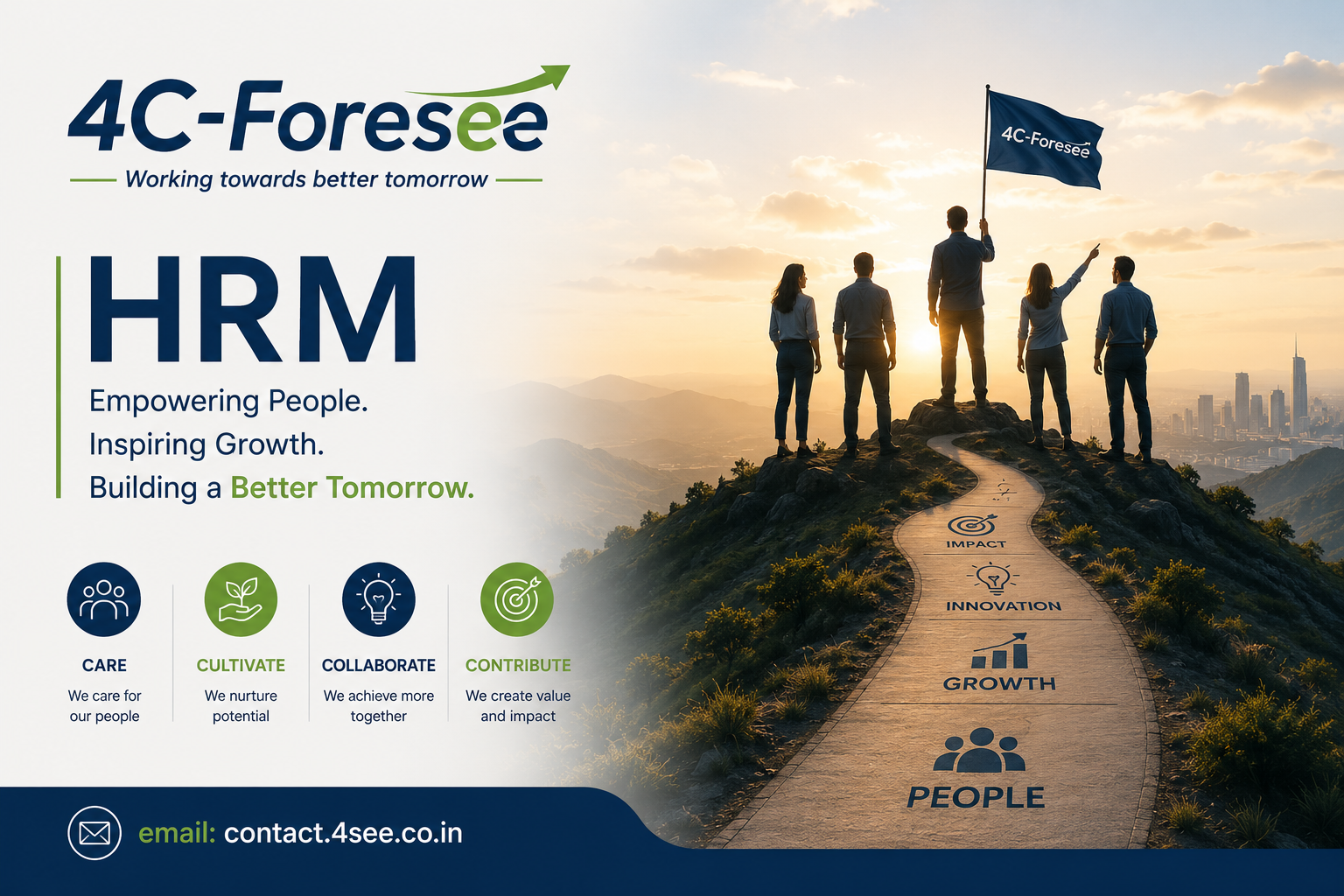
Organizations grow when their people grow. HR is the catalyst that transforms potential into performance.
The strategic management of human capital is the ultimate foundation of institutional stability. Today, organizations must view learning and skill adaptation not as static operations, but as continuous, life-long processes. At 4C-Foresee, we help corporate leaders systematically coordinate talent pools by aligning behavioral patterns directly with corporate values and national growth milestones, ensuring clear execution paths under all market circumstances.
01. HRM- I
Human Resource Management is a process of bringing people and organisations together so that the goals of each are met, it is concerned with effective use of people so that they give their best to the organisation. The contents are many 4C-Foresee vast knowledge and experience will make a marked difference for companies.
02. HRM - II
Strategy, Strategic Management and Process. Increasing the Sales shuold be the only strategy, but for that it requires strategy, a unified course of action, pattern of decisions, aimed at achieving the goals,vision, mission and objectives of the company.
03. HRIS ( HR -Information Systems)
HRM is a series of integrated decisions that form the employment relationship, set of programmes, functions and activities designed and carried out for organisational effectiveness. HRIS is vital to success of HR Function. Information Technology (IT) is a driving force helping business organisation to face challenges of today's competitive business environment. Specialised training is required for applying various HRIS tools
04. Intrapreneurial Ecosystems
Developing structural coaching sandboxes that stimulate and reward bold employee initiative, generating internal innovations.
05. Recruitment Management
Ask any CEO, what is his chief concern is and the answer is "People", people make the difference.Success of the organization utilmately depents on its employees, the selection task is the most important for all the decision makers.
06. Talent Density Optimization
Talent Acquisition is the buzzword now.Systematic sourcing of elite, mission-aligned leadership candidates to fill high-consequence corporate, operational, and strategic roles.Auditing employee skill sets and redistributing human resources to high-yield pipelines, reducing structural capital waste.
07. Executive Performance Coaching
Providing custom-tailored mentorship paradigms to synchronize senior leadership behavior with broader institutional targets.
08. Succession & Continuity
Establishing secure transition paths and training schedules to protect active operations from unexpected personnel changes.
09. Lifelong Learning Labs
Designing comprehensive corporate training tracks covering soft skills, digital transformation, and advanced operational disciplines.
10. HR Analytics & Diagnostics
Applying data-driven telemetry layers to track employee satisfaction, locate performance blocks, and minimize turnover.
11. High-Reliability Operations
Building disciplined performance standards and health protocols to guarantee continuous, zero-error execution in critical sectors.
12. Compensation Architecture
Engineering fair, result-oriented wages, salaries, compensation strategies and performance-driven incentive systems that keep teams motivated.
13. Change Management Support
Guiding workforce talent gracefully through complex corporate restructurings, M&As, and technological transitions.
14. Sovereign Compliance Standards
Enforcing absolute regulatory alignment with local labor laws, safety metrics, and corporate governance standards internationally.
15. Asset Development
Is the strategic practice of treating employees as appreciating corporate investments rather than consumable expenses. Instead of just managing headcount costs, this framework focuses on expanding the economic value of the workforce by continuously upgrading employee skills, knowledge, and psychological capabilities. Streamlining internal continuous-learning networks to optimize professional development curves and increase retention yield.
16. Governance Security
The formalized framework of policies, personnel, and procedures an organization uses to manage security risks and ensure security initiatives align with business objectives. It establishes accountability, outlines leadership responsibilities, and ensures compliance with legal and regulator. Equipping multinational executive boards with data-secure succession frameworks designed to safeguard brand authority.
17. Behaviour Culture Alignment
Every human is unique and so is his behaviour. He/She has a several physiological and psychological features that cause their response. Thinking process, problem solving process, how these features affect the performance levels of individuals and organisation. .
18.Business Communication
Communication is central to everything that we do, , it is that mortar that holds an organisation together, whatever its business or size, success or failure depends on the ability to communicate effectively with other members, creations and maintenance of relationships. Inculcating shared values like commitment, critical thinking, and customer centricity to secure operational synergy across departments. Communication in an organization, Internal-External, its channels are be thought and trained and developed freuent.
19. Performance Mgmt and Rewards System
Performance has many dimensions, output, result, time, focus, quality, cost, Performance management is the process of creating a work environment or setting in which people are enabled to perform to the best of their abilities and talents. It involves process, planning, observation,monitoring, developing,feedback, rating and rewarding employee performance.
20. Effective HR Training and development strategy.
New developments and rapid changes have made continous Training and Development programmes a vital part of HRM, it is mandatory to build up a strong, efficient, effective, motivated and dedicated managerial cadres, Employees are the most expensive resources in most business, and the one that depreciates the fastest and needs most constant replenishment. Building expertises, enhancing productivity and improving organisational functioning,
21. Business Etiquette and Effective Presentation
Manners make the man, to a great extent, companies and organizations are judged by the manner its executives conduct themselves. People are the biggest assets. Infosys' Chief Mentor. Mr.Narayan Murthy says that his challenge is to ensure that his assets (people)return to work the next day with a smile on their face raring to go. Courtesy and consideration go on a long way in ensuring that happens.
22. Managerial Economics
The body of knowledge which emerges to facilitate the process of managerial decision making in shaping efficiently the destiny of the firm constitutes the subject matter of Managerial Economics. No single firm works in isolation, t has to consider the reactions of rival firms, the possibility of government interferences through taxation, tariffs, export and import policies, the cyclical changes in the levels of business activities, the policy of FDI, disinvestment, liberalization and globalizationm risks and uncertainities.
23.Financial Management
Human Resources (HR) and Finance are two core pillars of business, When these two departments collaborate, they bridge the gap between people and profits, budgeting for human capital, performance based compensation, compliance and risk management. Ferocity of competition is likely to deepen further, it would be worthwhile for companies to take strategic measures for survival and growth.
24.Marketing Management
Marketing is much more than selling and advertising, products do not sell themselves. While marketing builds your brand's external reputation, HR shapes the internal culture that delivers on that brand promise, Together, they drive Employer Branding, using targeted messaging to attract, hire, and retain top talent in a competitive job market. In the ever-evolving business landscape, the lines between distinct corporate functions are increasingly blurring, leading to a more integrated approach to organizational success.
25.Strategic Management
The struggle for existence of growth is indeed very hard for firms in a competitive environments, fortunes of companies change some times very fast and drastically. Stategic management is an orderly process by which top management determines organizational objectives, strategies,Formal Planning, Informal planning, tactical planning, enterprise strategy, Policy, Strategic Busines Unit, Operations, strategic, HR and Administration decisions,
26. Industrial Relations and Labour Laws
Constitute one of the most delicate and complex problems of modern industrial society which is characterised by rapid change, industrial unrest, and conflicting ideologies in the national and international spheres. Production and Productiviy is off prime importance, avoiding unhealthy atmosphere in the industry is work of HRD. Any problem in industrial relations has to be approached on a multi-disciplinary basis.
27. Industrial psychology
Psychology is defined as the study of man and his behaviour with the aid of scientific methodology. its deeper understanding of behaviour of people working in industry, the general tendency in human beings to resist chanves of any sort and maintain a status quo. No two individuals are alike, these individual diferences both in physical and phsychological characteristics of the individuals form the very basis industrial phsychology. .
28. I.T for Management
Information is power, the currency of today is Time, Information and knowledge and human talent. During an business intelligence phase the decision maker either looks for a problem to solve or if a problem has been identified he works towards defining it correctly. Discovering Patterns, Identifying Growth opportunity, structured EIS(Executive information system). Visualizing a software solution, software testing, information security and long range planning of information systems and technology. .
29.International HRM
A merchant has no nation, It means that a businessman can view the entire world as one country of operations. The entire globe is just like one country for business, erasing national and political boundaries for the purpose of business may be termed as globalisation. Managing Culture diversity requires International Human resource planning.Recruitment and Development, Performance Management, Training and Development and Compensation and Benefits, and developing International Industrial relations
30. Industrial Relations and Labour Laws
Constitute one of the most delicate and complex problems of modern industrial society which is characterised by rapid change, industrial unrest, and conflicting ideologies in the national and international spheres. Production and Productiviy is off prime importance, avoiding unhealthy atmosphere in the industry is work of HRD. Any problem in industrial relations has to be approached on a multi-disciplinary basis.
31. Creating a Winning Team
Any workplace can benefit from ongoing professional development training that covers topics related to the business, Being aware of options can help the companies and its HRD team to be strategic, Exploring training topics on different subjects(safety, diversity,communication,leadership, teamwork, wellness, productivity, marketing, sales, finance, HR, Professionalism) is a great way to build the breadth of your professional abilities and knowledge. .
32. Functional Administration
To get things done in pursuit of accomplishing defined objectives. Administration, it is the function of determining the policy and also a process or activity of running a business organisation. It is the force which lays down the object for which an organisattion and its management are to strive and the the broad policies under which they have to operate.